Who is “They”?

  • Who is “they”? This is the most critical question, as it seeks to unmask the unspecified. Can the speaker be explicit? Does the author feel comfortable attaching more detail to the group being labeled? In large organizations, sometimes asking for clarity on who “they” is forces someone to realize that they don’t actually know who instituted a policy, or aren’t really sure where guidance came from – it was just accepted as coming from “them” and accepted as real. 

    And to quickly address the obvious: it’s not technically grammatically correct to frame the question as “who is they”. By convention, “who are they” is correct. But sometimes “they” can be a proxy for one person who may or may not have been speaking on behalf of a group.

    “They said no parking here.” 

    “Who is they?”

    “Some lady walking down the other sidewalk.”

    “Does the lady walking down the sidewalk have some kind of authority? Or are we just assuming she is right and deputized to speak on behalf of enforcement.”

    “I’m not sure…maybe we can park here.”
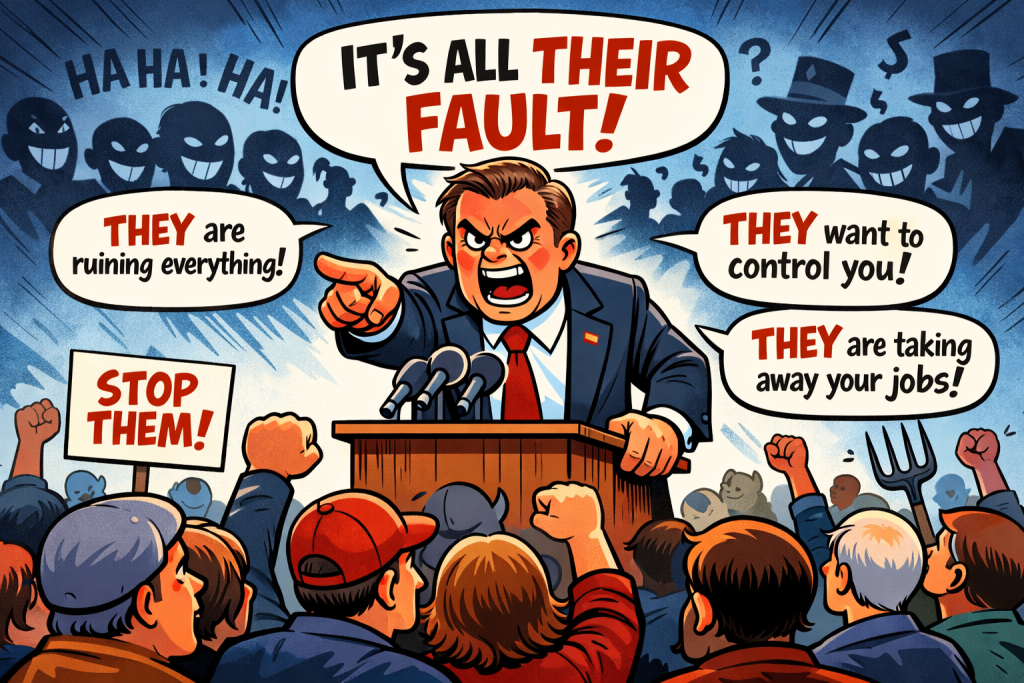
  • So what can be done? How can we fight back against the pernicious they? 

    I think it can be distilled down to three simple, sequential questions – and sometimes all three questions aren’t necessary to improve clarity, incorporate nuance, and seek understanding.

    1. Who is they?
    2. Are they all they?
    3. Why are they like that?

    More on these questions shortly, but in the mean time, try them out next time someone drops a pernicious they.

  • In most usage, they plural affords the same convenience as the other pronoun groups – shorthand for a known group after already identified. “The Jeffersons went on vacation. They saw the Grand Canyon and flew into Las Vegas. They said it was the trip of a lifetime!” No issues here, sounds like fun.

    But what happens when “they” is unspecified? In a society, there are many groups, and different groups can refer to each other as “they” without issue provided the reference is clear.  But the ambiguous they? Without specifics, the audience might be assuming references to wildly different groups under the same banner – it becomes an ink blot test. It can be any group you want.

    In this way, “they” is inflammatory, it is incendiary, it is divisive, and it is subtle

    Politicians in particular utilize they tactically in stump speeches to build alignment in the abstract when the specifics might be too inconvenient. “They’re all criminals” could mean ex-convicts to one audience member, all people of a race to another. And the speaker is fine with the unspoken confusion so long as both heads nod and eventually donate.

  • Thoughts on the most dangerous word in language – when people use it carelessly, why it’s so pervasive, and what we can all do about it

    (more to come very soon)

    In the mean time, if you see it, tag it #perniciousthey

    X: @perniciousthey

    Insta: @perniciousthey